How to keep score in baseball
First time keeping the book for your kid's team? Here is what the scorebook is for, how the positions are numbered, how to fill in one square, and what the common symbols mean.
What the scorebook is for
The scorebook is the game's record. Each batter gets a row, and each inning gets a column, so every square is one trip to the plate.
From the book you know who is up next, how each batter did, how many outs there are, and how many pitches each pitcher has thrown. The stats come from it after the game.
The position numbers
Every fielder has a number. You write plays with the numbers, not the names.
- 1 Pitcher
- 2 Catcher
- 3 First base
- 4 Second base
- 5 Third base
- 6 Shortstop
- 7 Left field
- 8 Center field
- 9 Right field
The numbers go around the infield, then the outfield from left to right. The one that trips people up: the shortstop is 6, even though the shortstop plays between second and third.
One square, step by step
Each square has a small diamond. Home is at the bottom, first on the right. As your batter moves around the bases, you draw the path.
1. Your batter singles
Draw a line from home to first and write 1B in the corner.
2. The runner moves up on a ground out
The next batter grounds to the shortstop, who throws to first: 6-3, one out. In that batter's square write 6-3 and circle 1 for the first out. Back in your batter's square, draw the line on to second.
3. The runner scores
A hit brings your runner home. Finish the lines around to home and fill in the diamond. A filled diamond means a run.
Common scorekeeping symbols
- K
- K
Strikeout looking (backwards K)
The umpire called strike three and the batter didn't swing. Paper scorebooks draw the K backwards.
Frozn Rope writes K for every strikeout and says beside it whether it was looking or swinging.
- BB
- HBP
Hit by pitch
A pitch hits the batter, who wasn't swinging and tried to get out of the way, and the batter goes to first.
- 1B
- 6-3
Ground out, shortstop to first
The shortstop (6) fields the grounder and throws to first base (3) for the out. Write the fielders in the order the ball went.
- F8
Fly out to center
The center fielder (8) catches a fly ball. A line drive caught is L, a pop up is P.
- 6-4-3
Double play
Shortstop to second for one out, then on to first for the second. Two outs on one play.
- FC
Fielder's choice
The fielder throws out a runner ahead of the batter instead of the batter, and the batter reaches base. It isn't a hit.
- E6
Error on the shortstop
The shortstop misplays the ball (a fumble, a drop or a bad throw), and that lets the batter reach or a runner move up. It isn't a hit.
- SAC
Sacrifice bunt
With fewer than two outs, the batter bunts and is out at first, but a runner moves up. It doesn't count as an at-bat.
Some books write SAC, others SH. Frozn Rope writes SH.
- SF
Sacrifice fly
With fewer than two outs, a fly ball is caught and a runner tags up and scores. It doesn't count as an at-bat.
Rule numbers are from the 2026 Official Baseball Rules. Position numbers and symbols like the backwards K are scorebook custom, not rules. Your league may add its own.
Or tap it on your phone
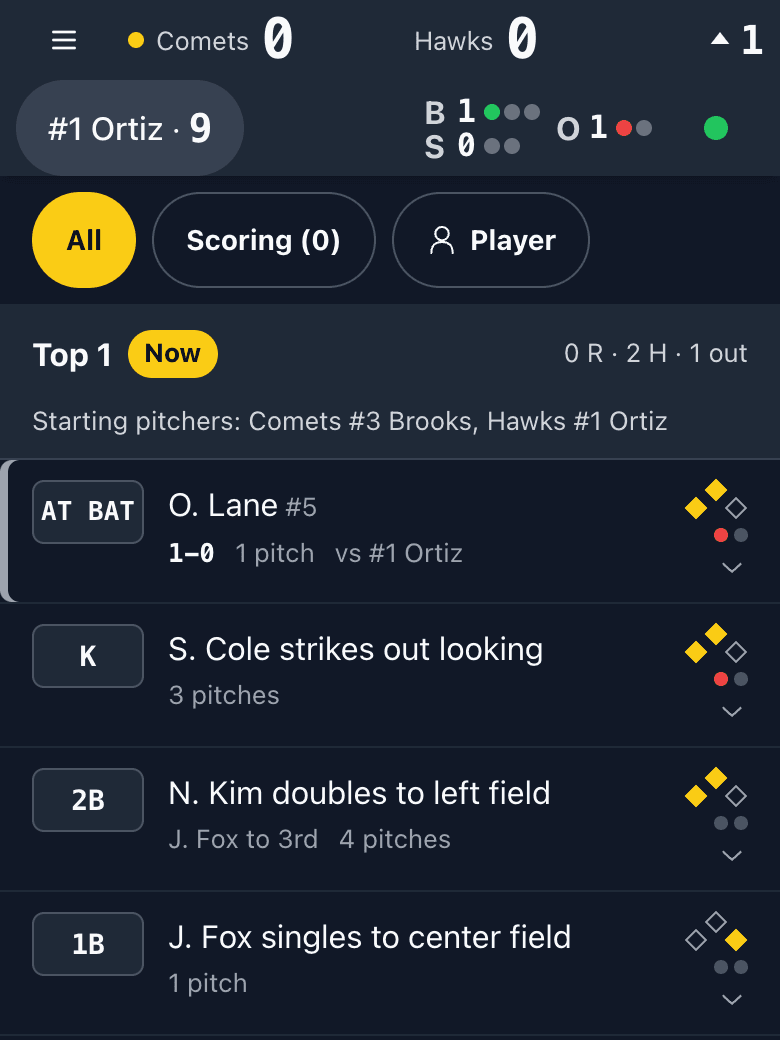
Frozn Rope writes the same codes in its Plays list: 1B, K, 6-3, F8, E6, SF, with the play in plain words beside each one. It works out outs, runs and pitch counts for you.
Scoring a youth game? Tap each pitch and the result of each play, and families can follow along from one link.
Keep the book without the pencil
See how live scoring in Frozn Rope works, or check the youth baseball pitch count rules.